
A Visit to the Recycling Battlefield
Jim Newcomer, LOSN Waste Reduction Team, May 4, 2026
When you drop a plastic bottle in your mixed recycling roll cart and drag it out to the street for curbside pickup, does it really get recycled? Or does the hauler just send it to a landfill or ship it off to Asia, where it becomes someone else’s burden? How much of that stuff is actually channeled back into our economy as new products or packaging?
Recently a group of Lake Oswego citizens, organized by LOSN, set out to find the real answer – right here in Clackamas County.
On a Wednesday evening in March, about 20 of us met at Pioneer Materials Recovery Facility (called a MRF for short) in Clackamas,Oregon. The dedicated employees process the contents of curbside co-mingled recycling bins from Portland and, in fact, from many towns in Oregon. Separating items by source material is critical to sending them to the customers for reuse/recycle.
The tour idea originated with our LOSN Waste Reduction Team; and we invited the Program Manager for Metro’s Master Recycler program, Stacy Ludington and Sara Stith, the new Sustainability Program Manager for Lake Oswego, to join us.
We carpooled from LO to the facility in Clackamas. Stacy provided the headsets used by Master Recycler trainees for us to use so that we could hear our guide in the materials processing area. Once everyone was outfitted with the headsets and other safety gear, we stepped inside the building and into a meeting room for a brief overview of the company from our tour guide, Mike Smith, the Warehouse Manager for this facility. Pioneer started as a local company operating in Tacoma and Portland. In 2024, it became a subsidiary of a national conglomerate called Waste Connections, Inc. With that merger came the capital funding to upgrade equipment to process larger quantities of material to a higher purity.
Mike explained that Pioneer receives all the mixed recycling that is picked up curbside by trash haulers in Portland and many other local jurisdictions, although not Lake Oswego. The new extended producer responsibility law that recently took effect requires all towns in Oregon to recycle the same materials, and so Pioneer processes recycled goods trucked in from as far away as Baker City and Ashland.
At the beginning of the process, the mixed materials are tipped onto an angled conveyor belt and transported upwards to mechanical fingers that separate the high value OCC cardboard first. Another conveyor on the next level is crowded with workers who stand by the fast-moving belt picking out by hand the material that cannot be recycled here, such as plastic grocery bags, and watching the main stream flow over the end and drop onto the next belt, where others, still picking by hand, begin sorting the plastics from the paper, and then on to the next stages where they use mechanical and visual sorting methods to further separate materials by composition (metal, plastic, paper).
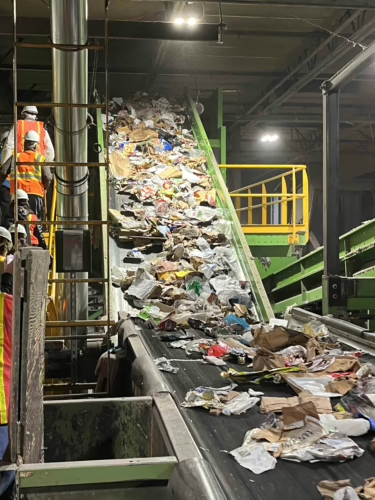
If anything, the noise intensified. Blowers were blowing the lighter materials up, grids with holes of various sizes were letting smaller pieces or cans fall through, and magnets were picking out the steel cans and chunks to separate them from aluminum and other non-ferrous metals. At one point a single one-armed robot was identifying and snatching small pieces that the operators had missed on the fast-moving conveyor belt.
Once the individual materials are separated (paper, cardboard, tin cans, plastic milk jugs, colored detergent bottles, etc.), they further refine the separated materials to remove the small pieces of foreign material that would contaminate a shipment. Finally, the separated materials are baled into six-foot cubes that weigh up to a ton apiece, and these are shipped to paper mills, steel plants, and plastic recycling facilities all over the country.
Pioneer prides itself in achieving a high degree of purity of the material for one main reason: the price they can command for it depends on the purity of their product. The accuracy of sorting is the heart of the operation. High purity equals higher prices; low purity, low prices. The market is a relentless disciplinarian, and Pioneer claims that their product maintains the highest purity in the business.
After touring the process up close, climbing up steel ladders, walking across catwalks, listening to explanations from our tour guide as we stood high up on platforms, and finally emerging on the plant floor, we went outside and gazed up at the bales of cardboard, plastics, steel cans, aluminum cans, and paper, all ready to ship out. With the background noise now at a minimum, our tour guide, Mike Smith, the Warehouse Manager offered us an impromptu Q & A session.
A few key learnings:
- Do you pay the trash haulers for the material they bring you? Answer: No
- How much of your end products do you ship overseas Answer: None – By Law!
- Are you able to sell all your products to recycling plants (Answer: Yes.)
The good news is that every scrap of the recyclable materials (those allowed in our curbside co-mingled recycling bins) is recycled; nothing is landfilled except the contaminants they pick out of the stream, roughly 5% of their intake. Tour participant Sara Hammons commented about the tour “I found it interesting that the materials get run through the facility multiple times if needed until they get to their proper place or are confirmed garbage.”
Surprisingly (for us, at least) the company pays their employees well, provides health care, paid vacations, time off, and other benefits, such as support for higher education of both employees and their family members. As a result, there is low employee turnover. We were impressed by the enthusiasm for their work that we experienced from everyone we met at Pioneer.
As Oregon’s new recycling law, the Extended Producers Responsibility Act, takes effect, funding will be provided to Pioneer and other MRF’s to use to enhance their existing equipment, including robots and AI technology. They will automate some of their picking lines even further, and they will increase their capacity to handle even greater incoming loads.
So in answer to our original question: Does your curbside recycling really get recycled?
You bet it does. Pioneer is banking on it.
