A Visit to the Recycling Battlefield

Jim Newcomer, LOSN Waste Reduction Team, May 4, 2026

When you drop a plastic bottle in your mixed recycling roll cart and drag it out to the street for curbside pickup, does it really get recycled? Or does the hauler just send it to a landfill or ship it off to Asia, where it becomes someone else’s burden? How much of that stuff is actually channeled back into our economy as new products or packaging?

Recently a group of Lake Oswego citizens, organized by LOSN, set out to find the real answer – right here in Clackamas County.

On a Wednesday evening in March, about 20 of us met at Pioneer Materials Recovery Facility (called a MRF for short) in Clackamas,Oregon. The dedicated employees process the contents of curbside co-mingled recycling bins from Portland and, in fact, from many towns in Oregon. Separating items by source material is critical to sending them to the customers for reuse/recycle.

The tour idea originated with our LOSN Waste Reduction Team; and we invited the Program Manager for Metro’s Master Recycler program, Stacy Ludington and Sara Stith, the new Sustainability Program Manager for Lake Oswego, to join us.

We carpooled from LO to the facility in Clackamas. Stacy provided the headsets used by Master Recycler trainees for us to use so that we could hear our guide in the materials processing area. Once everyone was outfitted with the headsets and other safety gear, we stepped inside the building and into a meeting room for a brief overview of the company from our tour guide, Mike Smith, the Warehouse Manager for this facility. Pioneer started as a local company operating in Tacoma and Portland. In 2024, it became a subsidiary of a national conglomerate called Waste Connections, Inc. With that merger came the capital funding to upgrade equipment to process larger quantities of material to a higher purity.

Mike explained that Pioneer receives all the mixed recycling that is picked up curbside by trash haulers in Portland and many other local jurisdictions, although not Lake Oswego. The new extended producer responsibility law that recently took effect requires all towns in Oregon to recycle the same materials, and so Pioneer processes recycled goods trucked in from as far away as Baker City and Ashland.

At the beginning of the process, the mixed materials are tipped onto an angled conveyor belt and transported upwards to mechanical fingers that separate the high value OCC cardboard first. Another conveyor on the next level is crowded with workers who stand by the fast-moving belt picking out by hand the material that cannot be recycled here, such as plastic grocery bags, and watching the main stream flow over the end and drop onto the next belt, where others, still picking by hand, begin sorting the plastics from the paper, and then on to the next stages where they use mechanical and visual sorting methods to further separate materials by composition (metal, plastic, paper).
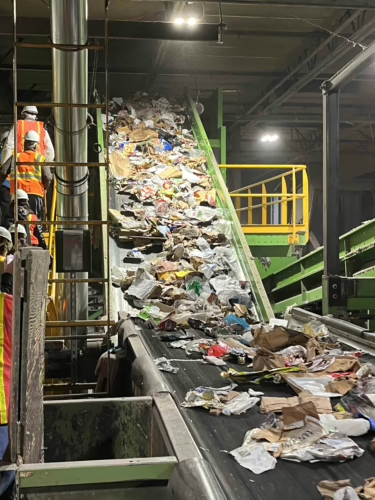
Photo of recyclables on a conveyor belt to be sorted.

If anything, the noise intensified. Blowers were blowing the lighter materials up, grids with holes of various sizes were letting smaller pieces or cans fall through, and magnets were picking out the steel cans and chunks to separate them from aluminum and other non-ferrous metals. At one point a single one-armed robot was identifying and snatching small pieces that the operators had missed on the fast-moving conveyor belt.

Once the individual materials are separated (paper, cardboard, tin cans, plastic milk jugs, colored detergent bottles, etc.), they further refine the separated materials to remove the small pieces of foreign material that would contaminate a shipment. Finally, the separated materials are baled into six-foot cubes that weigh up to a ton apiece, and these are shipped to paper mills, steel plants, and plastic recycling facilities all over the country.

Pioneer prides itself in achieving a high degree of purity of the material for one main reason: the price they can command for it depends on the purity of their product. The accuracy of sorting is the heart of the operation. High purity equals higher prices; low purity, low prices. The market is a relentless disciplinarian, and Pioneer claims that their product maintains the highest purity in the business.

After touring the process up close, climbing up steel ladders, walking across catwalks, listening to explanations from our tour guide as we stood high up on platforms, and finally emerging on the plant floor, we went outside and gazed up at the bales of cardboard, plastics, steel cans, aluminum cans, and paper, all ready to ship out. With the background noise now at a minimum, our tour guide, Mike Smith, the Warehouse Manager offered us an impromptu Q & A session.

A few key learnings:

  • Do you pay the trash haulers for the material they bring you? Answer: No
  • How much of your end products do you ship overseas Answer: None – By Law!
  • Are you able to sell all your products to recycling plants (Answer: Yes.)

The good news is that every scrap of the recyclable materials (those allowed in our curbside co-mingled recycling bins) is recycled; nothing is landfilled except the contaminants they pick out of the stream, roughly 5% of their intake. Tour participant Sara Hammons commented about the tour “I found it interesting that the materials get run through the facility multiple times if needed until they get to their proper place or are confirmed garbage.”

Surprisingly (for us, at least) the company pays their employees well, provides health care, paid vacations, time off, and other benefits, such as support for higher education of both employees and their family members. As a result, there is low employee turnover. We were impressed by the enthusiasm for their work that we experienced from everyone we met at Pioneer.

As Oregon’s new recycling law, the Extended Producers Responsibility Act, takes effect, funding will be provided to Pioneer and other MRF’s to use to enhance their existing equipment, including robots and AI technology. They will automate some of their picking lines even further, and they will increase their capacity to handle even greater incoming loads.

So in answer to our original question: Does your curbside recycling really get recycled?

You bet it does. Pioneer is banking on it.

Learn how sustainable landscaping is clean, quiet and healthy!

Newsletter header image - LOSN Sustainability Insider
Bee pollinates garden flowers

Sustainable Landscaping
It’s Clean, It’s Quiet, It’s Healthy!

The mission of the Sustainable Landscaping action team is to usher in a new era of landscape practices that restore the environment, protect public health, and encourage long-term sustainability, increased biodiversity, and enhanced resilience. Our goal is to eliminate gas-powered landscaping equipment (GPLE) in Lake Oswego by the first part of 2027.

City of Lake Oswego Council Goals

In response to growing public concern, local governments, states, utility companies, and other entities across the country have adopted policies and programs to address the harmful pollution and noise generated by GPLE.

Earlier this month, the Lake Oswego City Council adopted a 2026 goal, with encouragement from LOSN and many people in the community to phase out the use of gas-powered landscaping equipment. Please thank the City Councilors and let them know that you appreciate their commitment to eliminating gas-powered landscaping equipment.

It is important that they hear from you.

This goal is a continuation of a city goal adopted in 2025. Here is the 2026 goal:

“Explore and continue outreach and policy research in regard to phasing out gas-powered lawn equipment. Bring recommendations to the City Council in early 2027”.

We want to thank the City Council for continuing to include this goal to phase out gas-powered landscaping equipment and for their commitment to creating a clean and safe Lake Oswego. The city has a lot on its plate this year, along with the transition to a new City Manager and Sustainability Manager. We are very appreciative of the city’s willingness to make this a priority.

What does the city need to accomplish before they can put an ordinance in place to phase-out gas powered landscaping equipment?

The city will need to create a program to administer the ordinance and establish structures to receive citizen complaints, enforce the phase-out, help landscaping business owners transition to new equipment, and more. City staff will be working on these issues during the upcoming year.

At LOSN, we have committed to using our resources to help the city review programs and ordinances from other communities, brainstorm ideas, and come up with solutions.

What can we do right now?

In the meantime, it remains critical that we take action as individuals to eliminate the use of GPLE at our homes, schools, and businesses, especially the use of gas leaf blowers. The faster we transition to more sustainable landscaping practices, the sooner we will all experience the multitude of benefits.

Here are some simple but powerful steps we can take personally that will directly and dramatically impact the collective health and overall quality of life in our neighborhood. If you use a landscaper, please ask them to adopt these practices!

  • Leave the leaves! – They provide habitat for beneficial insects, nutrients for the soil, carbon absorption, and moisture retention.
  • Avoid the use of all leaf blowers around plantings. Leaf blowers erode and compact the soil and destroy habitat for insects and pollinators.
  • Use rakes and brooms instead of blowers on hardscapes. Using a blower sends pollution, dust, pollen, mold, and fine particulates into the air.
  • If you or your landscaper still needs a power assist on hardscapes (e.g., driveways, parking areas, or sidewalks), use electric tools instead of gas-powered; they’re affordable and effective, and they’re cleaner and quieter than their gas counterparts. Be mindful of people and animals nearby, and avoid blowing onto the property of others or into storm drains.
  • Share your electric tools with your landscaper and neighbors. Plan to provide your landscaper with a fresh battery or extension cord on your day of service.
  • Adopt the practices of regenerative landscaping, whether it’s you or someone you hire who is caring for your garden.
Photo of a Black-capped Chickadee sits on the wooden handle of a garden fork. It used the tool as a staging sot before the feeders. The photo symbolizes the closeness between chickadees and people.

Regenerative Landscaping: Landscaping with Nature

Regenerative landscaping is landscaping with nature. It focuses on restoring the environment and promoting long-term sustainability for all of the plants and animals that make up our urban landscapes. It differs from conventional landscaping by prioritizing the health and sustainability of the ecosystem rather than aesthetics alone.

Benefits of Regenerative Landscaping

  • Enhanced resilience for trees and plants in our yards
  • Reduced water use
  • Lower maintenance costs
  • Increased biodiversity
  • Elimination of toxic chemicals that affect human and ecosystem health
  • Harmony with natural processes

Principles of Regenerative Landscaping

  • Support healthy soil
    • Limit soil disturbance
    • Maximize roots in the soil
    • Keep covered with plants or compost
    • Maximize diversity of soil microorganisms
  • Support plant and animal diversity by providing varied habitats
  • Eliminate the use of toxic chemicals
Image of bees hovering over flowers

Our Work

We’ve been busy as bees, and thanks to your support and the hard work of our team, we’ve accomplished quite a bit. Here are some highlights of our work and what’s ahead.

Please consider joining our team or making a donation.

  • Researching ordinances and policies from communities that have GPLE bans.
  • Tabling at many community events.
  • Partnering with community organizations.
  • Establishing relationships with landscape battery equipment vendors.
  • Creating marketing and educational materials, yard signs, newsletters, resource filled website. Thank you to the City of Lake Oswego for the two Municipal Grants we have received to help with this campaign.
  • Our successful letter-writing campaign amplified awareness of the negative impacts that the use and overuse of GPLE is having in Lake Oswego. Thank you for speaking up – your words have power!
  • We’ve published a list of landscape professionals serving Lake Oswego who offer alternatives to GPLE. Do you know of a landscaper willing to offer gas-free landscape maintenance? Let us know – we would love to promote them by including them on our list!
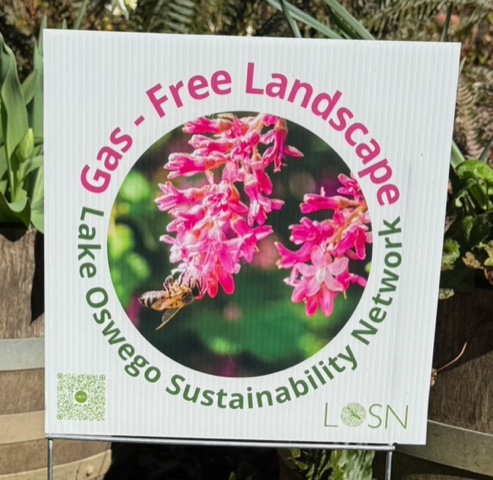
Photo of the "Gas-Free Landscape" LOSN yard sign in front of greenery

Request Your Healthy Yard Care Sign Today!

We’ve created beautiful yard signs promoting a Gas-Free Landscape. Studies show that the actions of our neighbors influence our choices. Adopting gas-free practices and displaying one of our signs will help build awareness, and may encourage others in your neighborhood to follow suit.

What’s Next?

  • We’re continuing to expand and grow the Healthy Yard Care/Regenerative Landscape aspect of our work – to foster a community-wide model of clean, quiet and healthy practices that support all living members of our beautiful neighborhoods.
  • We’re partnering with the City of Lake Oswego on education, research and outreach in preparation for the phase-out of GPLE.
  • We’re expanding our residential landscaper list to include and promote commercial landscapers who offer alternatives to gas-powered landscaping in Lake Oswego.
Photo of healthy yard signs among flowers and in front of a hedge
Photo of the healthy yard care team at the 2024 EV Fair

Spread the Word!

Image of a hovering bee

Write a letter to the editor.

Image of a hovering bee

Ask your HOA or Neighborhood Association to contact us to schedule a 15 minute presentation on Sustainable Landscaping. In the last year, we have given presentations to 10 neighborhood associations.

Image of a hovering bee

Forward this newsletter to others, and ask your HOA or Neighborhood Association to post this newsletter online and/or email it to their listserv.

Image of a hovering bee

Follow us on social media!

Celebrate fall with Oregon’s white oak

What to Expect at the Electric Home and Vehicle Fair

September 2024

Orientation to the Lake Oswego Electric Home and Vehicle Fair

The Lake Oswego Electric Home and Vehicle Fair has opportunities for getting information, advice and answers to your questions.

Check out our Home and Vehicle Fair event page for complete details.

Event Details

To get started, stop by the table of Electrify Now and meet Brian Stewart, its founder, and ask questions on the why and how of electrification (Brian is also giving a talk at 11:00). At the table next to Brian are members of our initial cohorts of “Electrification Coaches” who have finished their rigorous training through Rewiring America. One of them is Amanda Watson, the City of Lake Oswego’s Sustainability Program Manager. Ask a coach how to prioritize your electrification goals, find contractors, or find incentives. Or ask about becoming one of our growing cadre of coaches.

In the front of the church try a pancake and apple cider cooked on an induction hotplate. While you’re there you can listen to Noelle and Eli from Electrify PDX talk about many advantages of induction cooking. Matt Tidwell from PGE (an LOSN board member as well) will also be there to advise you on programs to help you manage your energy and lower your bills and to discuss your efficiency and electrification goals.

We are here to promote electrification, but, in fact, the first step in looking at your home is a consultation and an audit about tightening your building envelope. At GreenSavers a consultation helps you identify a list of priorities and tax credits. An audit gives you the information you need to make your home more energy efficient through sealing air leaks and adding insulation. An audit can not only make your home more comfortable but decrease the size and cost of a new HVAC system. Two companies at the fair specialize in making your home more energy efficient—GreenSavers and HomeRx.

Three HVAC contractors are available to advise you on heat pumps to heat and cool your home—GreenSavers, Climate Control and The Heat Pump Store. What a marvel the heat pump is–this amazing machine is 3-4 times more energy efficient than fossil gas or electric resistance heating, and there are tax credits and rebates available for heat pumps through the federal government and Energy Trust of Oregon.

GreenSavers and Climate Control offer both ducted and ductless heat pumps. The Heat Pump Store specializes in “mini splits”—wall-mounted heat pumps that do not require ducting systems. Additionally, GreenSavers can install heat pump water heaters that are so efficient that they will pay for themselves in a few years.

Conduit Electric has specialist electricians for many electrical tasks such as upgrading your panel, installing your vehicle charger, installing a manual transfer switch to connect to your portable generator and run several circuits in your home during an outage, and switching your gas to electric in the kitchen.

The Fair is delighted to welcome three sustainable residential building design/construction firms this year—BirdsmouthGreen Hammer and TaylorSmith Sustainable Construction. All three renovate and expand homes as well as build new homes and accessory dwelling units. They use sustainable materials and minimize waste during construction. Their homes often use passive design, a type of energy efficient building construction which dramatically decreases the need for heating and cooling. When combined with solar panels and batteries, the homes can even become “zero energy”—so efficient they consume almost no energy. These “high performance” homes are made with high quality construction materials and are meant to be comfortable, durable, healthy, and inexpensive to operate. The beauty of these homes is remarkable!

A new addition to the fair this year is our landscaping section. STIHL representatives will be available to demonstrate their line-up of battery-operated landscaping equipment including gardening tools, blowers, shredders, vacuums, and multi-task tools. In addition, if you employ a landscaping service and want to find one that does not use gas-powered equipment, you can meet four local landscaping companies who offer alternatives to gas-powered maintenance. Discover the benefits of a quiet, clean and sustainable landscaping service. Here is more information about our Electrify Your Landscaping/Healthy Yard Care campaign.

Learn more about these companies on our event page. Several offer discounts to fair attendees.  Here is the link to last week’s newsletter about solar at the fair.

Thank You to Our Electric Home and Vehicle Event Sponsors

Thank you to sponsors of the 2024 Lake Oswego Electric Home and Vehicle Fair

Striving for a More Sustainable City

LOSN Sustainability Insider

November 2021

LOSN Board Note: In this edition, we bring you exciting news about what is happening with Sustainability in the City.

Striving for a More Sustainable City

There is a lot to celebrate with respect to sustainability in the City of Lake Oswego. The accomplishments stretch across all aspects of city operations: transportation, energy efficiency, natural resource protection, and waste reduction.

We have a new Sustainability Program Manager, Amanda Watson (see Spotlight on Amanda below) and a dedicated volunteer advisory board to help the city continue down the path of sustainability stewardship. City Manager Martha Bennett says, “We try to look at sustainability not just with the environmental lens, but include the economic viability and social equity aspects as well. Everything is a balance of these three aspects. Public Safety for example is primarily focused on the social aspect, however includes environmental and economic aspects in its operations.”

There are some exciting sustainability opportunities coming up as well. The City is seriously considering rebuilding the Tryon Creek Wastewater Treatment Plant. Treatment plants are typically one of the biggest energy users in a community. This presents a wonderful opportunity to create the most sustainable plant possible. For more information about the status click here. The City has also entered an agreement with the Lake Oswego School District to build a Recreation/Aquatic Center. This presents another opportunity to build a future-focused sustainable facility.


City Sustainability Accomplishments

Over the last decade or so, the City has worked on some significant initiatives that have made our community better. We want to highlight a few of these accomplishments here. For an expanded list of actions for each of the areas: transportation, energy efficiency, natural resource protection, and waste reduction click here.

Major Accomplishments

  • In May 2020, City Council adopted a Sustainability and Climate Action Plan. The Plan builds on the City’s Sustainability Action Plan for City Operations (2014) and establishes community-wide climate action goals.
  • Earlier this year, City Council approved a contract for the use of electric landscaping equipment only for the City’s right of way landscaping, covering over 200 different sites.

Reduce Transportation Emissions

  • Purchased 3 EVs for the City fleet, as well as several hybrids and plug-in hybrids
  • Installed improved bike facilities for City staff and visitors at the new City Hall

Promote Energy Efficiency and Clean Energy

  • Energy saving technologies installed at Lake Oswego Tigard Water Treatment Plant save almost 2 million kWh/year in electricity
  • New City Hall was constructed to a LEED Gold standard and has been certified Gold by Clackamas County’s Leaders in Sustainability program

Protect Natural Resources

  • Increased landscaping equipment inventory, replacing with electric when possible. The City has an electric large area mower in its fleet in addition to electric blowers, weed eaters and a chain saw. Also they will have an Electric Greens mower for the golf course when it reopens.
  • Promoted pollinators by planting native wildflower seed in natural areas.

Reduce Waste

  • Reduced food waste sent to landfill by offering curbside organics collection for commercial businesses and single family residences beginning in 2016.
  • LO Library has a Library of Things collection that allows residents to check out items like small appliances, tools, musical instruments, and games, helping community members to try new things, save money, and reduce consumption of new products.

Meet our new city Sustainability Program Manager – Amanda Watson

Amanda Watson started in September as the City of Lake Oswego’s Sustainability Program Manager. In her role, she is responsible for implementing the City’s Sustainability and Climate Action Plan, in collaboration with other City departments and community partners. She also manages the City’s solid waste and recycling franchise with Republic Services, and serves as staff liaison to the Sustainability Advisory Board. Amanda previously worked at the City of Portland, where she served as lead on climate and sustainability policy for Mayor Wheeler. She helped to develop Portland’s Climate Emergency Declaration, which aligned the City’s emissions reduction goals with the Paris Agreement and committed to a climate justice-based approach to climate action. She also worked at the City of Portland’s Bureau of Planning and Sustainability on a project to increase equity in the waste collection system. Amanda has a Master in Public Policy from Harvard Kennedy School and a Bachelor of Science in Foreign Service from Georgetown University.

Amanda says, “I am excited to be working at the City of Lake Oswego and with the many engaged members of our community to build on the progress Lake Oswego has already made to become a more sustainable community and address climate change.”

The Lake Oswego Review had a great article about Amanda in October which you can read here.


Tesla Hits the Road with the Police Department

The Lake Oswego Police Department now has a Tesla. That’s great, but aren’t these cars really expensive? According to Police Chief Dale Jorgensen when he did the math it made economic sense. When you factor in that an operating an electric vehicle can save up to 70% over a gas one, it doesn’t take long for the car to pay for itself.

The Tesla is being used by the department’s detective group and has been assigned to a detective who drives the furthest distance making the savings even a little greater. For patrol work the department is converting to Ford SUV hybrids and will consider an all-electric SUV when one has been certified for routine patrol work.


The Sustainability Advisory Board Plays an Important Role for the City

The City of Lake Oswego launched its Sustainability Advisory Board (SAB) in 2008. It is a volunteer citizen advisory body appointed by the City Council consisting of seven members appointed for three-year terms, two alternates for one-year terms, and two youth members appointed for one-year terms. Currently the board is co-chaired by Stephanie Glazer and Kathleen Wiens. The other members are: Buzz Chandler, Susan Mead, Mark Puhlman, Jay Hamachek, Matt Schaeffer. Alternates are Kara Orvieto and Kim Roeland. Youth are represented by Anna Wallin and Olivia Reinhart. City Councilor Rachel Verdick is the Council Liaison for the board.

The Sustainability Advisory Board’s primary objective is to promote a more sustainable community that balances the three pillars of sustainability: social equity, the economy and the environment. The SAB works with the guidance of Amanda Watson, the City’s new Sustainability Program Manager, who brings a wealth of knowledge and experience to this role. Annually the board sets goals to advance sustainability in the city.

Click here for more on the SAB Goals for 2021.


Lake Oswego’s 3rd Annual Tree Summit a Big Success

The 2021 Lake Oswego Tree Summit, Sustaining Our Urban Forest: Resilience, Responsibility and Reciprocity in a Changing Climate, was a huge success.  Dr Christine Buhl, Oregon Department of Forestry Entomologist, shared pertinent and very interesting information about the effect of a changing climate on our urban forest and answered questions from the audience.  Dr. Buhl’s talk was followed by a presentation by the City of Lake Oswego on the LO Tree canopy based on analysis of recent LiDAR data.

A video of the presentation and other information, including how to get involved, can be found on the Oswego Lake Watershed Council website. Contact Stephanie at [email protected] if you have any questions.


LOSN November Forum: Beyond Net Zero, Restorative Buildings: the PAE Story

When:  Wednesday, November 17, 2001
Time:    6:30 pm to 8:00 pm
Where: on Zoom

What if a building was not just sustainable but restorative, a building that put back more than it takes?

That is the goal of the Living Building Challenge, a concept introduced on 2009, where its end goal “is to encourage the creation of a regenerative built environment. The challenge is an attempt to raise the bar for building standards from doing less harm to contributing positively to the environment.”

This is an approach that goes way beyond the LEED rating system focusing not only on net zero energy but also net zero water and waste.

One of the leaders in implementing this concept is Portland based PAE Consulting Engineers. They have eleven projects designed to meet this rigorous framework. The latest is their new headquarters here in Portland, a five story building which is set to be the world’s first developer-driven Living Building.

PAE president Paul Schwer will be joined by PAE associate Karina Hershberg to tell the story of how their building was able to reach this goal while simultaneously providing a return for their investors.

Electric Landscaping Update – April 2021

LOSN Sustainability Insider

April 2021

LOSN Board Note: Tackling climate change can seem to be an overwhelming proposition. But there is a key strategy which can make a major impact: Electrify Everything. Transitioning gas powered landscaping equipment to electric helps the community take meaningful action addressing climate change while also improving air quality and reducing harmful noise levels in our community.

Note: the format of our newsletter has changed. Scroll to the bottom for events and other updates.

Making the Switch to Electric Landscaping Equipment

Benefits of Switching

Communities all over the United States are targeting gas powered landscaping equipment in response to the noise and the air pollution they produce. Gas powered landscape maintenance equipment can create significant localized air quality hazards beyond simply carbon emissions.


Carbon emissions using gas powered equipment

In addition, this equipment is responsible for significant noise pollution which can lead to hearing loss and high stress levels. Operators of this equipment can be particularly affected by the noise and air pollution.

Community members are taking their concerns to their cities and neighborhoods looking for solutions. In our tri-county area, a volunteer organization in Portland has formed quietcleanpdx.org to educate and offer solutions about phasing out gas powered leaf blowers. Thus, beyond the benefits of directly addressing climate change by reducing carbon emissions, switching out gas powered landscaping equipment has major benefits for the well-being of our community.


Register for our May Forum: Come hear from Dan Mabe, Founder and President of American Green Zone Alliance (AGZA), talk about how we can transition from gas powered landscaping equipment to electric powered equipment which helps to reduce air and noise pollution.

Scroll down to the event section for more info.


City Action: City Council Approves All-Electric Landscaping Contracts

On February 2nd the City Council approved two 100% electric landscaping contracts that covers over 200 public areas in the City. This is a great step towards reducing the hazardous air and noise pollution that is caused by gas powered landscaping equipment. The city has already started purchasing electric landscaping equipment. By actively transitioning away from gas powered equipment and using electric equipment this will help create a greener and healthier place for the landscaping workers, community and the environment.


Residential Action: Where Can You Find Electric Landscaping Equipment?

You can find displays and aisles of residential electric landscaping equipment at your local Ace Hardware, Home Depot, and Lowe’s. This equipment works great and is often less expensive to purchase and operate. The electric equipment is quieter and does not have the toxic emissions of the gas powered equipment.

American Green Zone Alliance has compiled a list of field tested and certified commercial electric equipment: agza.net/agza-approved-equipment. This includes manufacturers, types of equipment, specifications, photos, and videos. Many commercial landscapers and communities have moved to electric equipment and are happy with the performance while having a cleaner and greener way to operate and not being exposed to air and noise pollution.

Image: Lake Oswego Ace Hardware Display


Landscaping Services Action: Local Electric Landscaping Services

A number of landscaping services in our region already offer electric services. A story from Oswego Yard Care shows why businesses are moving towards this model:

Dan Fidler and Lonny Chavez started Oswego Yard Care in 2019 with the desire to create a landscaping business using quiet renewable energy. They use all-electric battery powered Ego brand tools that greatly reduce noise pollution and have no gas fumes. Every kwh of energy they use to recharge their equipment is offset with the purchase of clean renewable energy. They have enthusiasm for innovation and insistence on clean energy. Oswego Yard Care maintains and creates beautiful yards by combining seasonal color, native plants and perennials. Dan and Lonny encourage other landscapers to check out their equipment to experience for themselves how great this electric equipment works. Visit oswegoyard.com for more information.

Here is a list of some local landscapers that use electric landscaping equipment and hand tools (let them know you are looking for electric landscaping care):


Works Great While Providing Surprising Resilience: Testimonial by Michael Earp

We have a large lot in the First Addition of Lake Oswego and although we have reduced the lawn size it is still a lot to mow. Over the years I have routinely used electric lawn equipment. At first cords were standard, which increased the time it took and were a hassle with messing with the cord. I can remember cutting the cord with the mower, too.

I upgraded to a cordless mower when they became available. The first cordless mowers cut down on the time spent mowing but they used lead acid battery which made the lawn mower heavier and the battery had to to be recharged half way through mowing my big lawn.

Today’s electric mowers are very light and have a long runtime with a powerful Lithium battery. It is so quiet and easy to push and can do the entire lot with no problem. There are a number of new Lithium battery powered mowers available. We use a Ryobi 20 inch 40 Volt cordless mower which comes battery charger included ($299 at Home Depot).

Ryobi makes a number of attachments and that the same battery can be used on. I have a few of them including: edger, blower (quiet), portable drill, vacuum, radio and inverter.

During the last ice storm I used the 40 Volt Lithium battery from my mower with the inverter to power my house TV for three hours on a charge. And I could have powered the refrigerator.

Once you use one of these new Lithium powered mowers you will never want to deal with a gas mower again. Skip the hassle with gas tuneups along with the noise and pollution. Your neighbors will appreciate it, too!


Why We Made the Switch: Testimonial from Jeff & Kathleen Wiens

For years it was frustrating trying to start our gas lawnmower and edger. Having to mix oil and gasoline, trying to find a funnel to fill it was always a hassle. The cloud of smoke and fumes made the process even more unpleasant. It was frustrating having to wipe the spilled gasoline off of our hands and ground.

In 2015 we decided to go all electric/battery for our landscaping equipment. We purchased a Black and Decker hedge trimmer and a Kobalt lawn mower at Lowe’s for a reasonable price. This equipment performs great and after 6 years they have held up well. We also like to use a rake and broom.

A few months ago we purchased an Ego electric chainsaw and a more powerful hedge trimmer from Ace Hardware. The batteries are interchangeable and long lasting. We purchased an Ego inverter after our recent power outage to be able to use these Ego batteries to run our refrigerator, TV, power lights, and charge our cell phones. Since we have several batteries, this could help get us through a power outage without the need to run a noisy and polluting generator.

What we like about electric landscaping equipment is when the battery is connected, it starts every time without any nauseous fumes and it’s quieter than gas equipment. We have found that that the cost of residential electric landscaping equipment is comparable or less than the gas equipment. A trip down the aisles at Home Depot or Lowe’s will verify this.

The noise level of gas equipment and the toxicity of the fumes are enough to warrant a change to electric. If homeowners don’t want to do their own landscaping, how about purchasing electric equipment to give to their landscapers. Another idea is to ask your landscaper to look into having an electric option. This would make it healthier for the workers, residents, neighbors and the environment. The switch to electric equipment helps to lower the carbon footprint created from gasoline powered landscaping equipment.


May Online Forum: Transitioning to Electric Landscaping Equipment

Speaker:  Dan Mabe, CEO, Founder and CEO of American Green Zone Alliance
When: Thursday, May 13, 2021
Time:  6:30 pm – 8:00 pm
Where:  Webinar on Zoom

Learn about how communities are moving toward pollution free,  electric landscaping equipment and services.

Come hear from Dan Mabe, Founder and President of American Green Zone Alliance (AGZA), talk about how we can transition from gas powered landscaping equipment to electric powered equipment which helps to reduce air and noise pollution.

Dan grew up in a landscaping family and in 2006 he created an all electric landscaping business which grew to 70 customers in one year. He started AGZA in 2010 to help prudently transition the landscape maintenance industry to cleaner and quieter technologies and operation.

AGZA’s efforts have resulted in the creation of green collar jobs, improved health of workers and communities, and greatly reducing environmental impacts.

Dan will discuss the air and noise pollution issues with gas powered equipment, the electric equipment that is currently available, the cost comparison between gas and electric and the return on investment. He will discuss what other communities with similar seasons are doing in regard to transitioning to electric. He will also talk about what we can do to help business owners transition to electric equipment

To learn more about our speaker and American Green Zone Alliance please visit agza.net.


Candidate Forum: LOSD School Board, April 27, 2021

Topic: LOSD School Board Candidate Forum
When: Tuesday, April 27, 2021
Time: 6:30 pm – 8:00 pm
Where: Webinar on Zoom

The Lake Oswego Sustainability Network (LOSN) and Respond to Racism in Lake Oswego are holding a virtual (Zoom webinar) candidate forum on April 27th. We want to give our community an opportunity to meet the School Board candidates and to hear their thoughts on a variety of topics related to diversity, equity, and inclusion (DEI), and sustainability in schools.


June Online Forum: Turning ocean waves into electricity

Speaker:  Burke Hales, Professor OSU, College of Earth, Ocean and Atmospheric Sciences
When: Thursday, June 10, 2021
Time:  6:30 pm – 8:00 pm
Where:  on Zoom

The PacWave project, to be built off the Oregon coast near Newport, will facilitate and speed up the development of new technology to harness the motion of ocean waves to generate electricity.  Our speaker, Dr. Hales, is Chief Scientist of the testing facility and will explain how this technology could someday provide a major source of clean energy for our region.