May 13, 2026 | Recent, Uncategorized, Waste Reduction
Jim Newcomer, LOSN Waste Reduction Team, May 4, 2026
When you drop a plastic bottle in your mixed recycling roll cart and drag it out to the street for curbside pickup, does it really get recycled? Or does the hauler just send it to a landfill or ship it off to Asia, where it becomes someone else’s burden? How much of that stuff is actually channeled back into our economy as new products or packaging?
Recently a group of Lake Oswego citizens, organized by LOSN, set out to find the real answer – right here in Clackamas County.
On a Wednesday evening in March, about 20 of us met at Pioneer Materials Recovery Facility (called a MRF for short) in Clackamas,Oregon. The dedicated employees process the contents of curbside co-mingled recycling bins from Portland and, in fact, from many towns in Oregon. Separating items by source material is critical to sending them to the customers for reuse/recycle.
The tour idea originated with our LOSN Waste Reduction Team; and we invited the Program Manager for Metro’s Master Recycler program, Stacy Ludington and Sara Stith, the new Sustainability Program Manager for Lake Oswego, to join us.
We carpooled from LO to the facility in Clackamas. Stacy provided the headsets used by Master Recycler trainees for us to use so that we could hear our guide in the materials processing area. Once everyone was outfitted with the headsets and other safety gear, we stepped inside the building and into a meeting room for a brief overview of the company from our tour guide, Mike Smith, the Warehouse Manager for this facility. Pioneer started as a local company operating in Tacoma and Portland. In 2024, it became a subsidiary of a national conglomerate called Waste Connections, Inc. With that merger came the capital funding to upgrade equipment to process larger quantities of material to a higher purity.
Mike explained that Pioneer receives all the mixed recycling that is picked up curbside by trash haulers in Portland and many other local jurisdictions, although not Lake Oswego. The new extended producer responsibility law that recently took effect requires all towns in Oregon to recycle the same materials, and so Pioneer processes recycled goods trucked in from as far away as Baker City and Ashland.
At the beginning of the process, the mixed materials are tipped onto an angled conveyor belt and transported upwards to mechanical fingers that separate the high value OCC cardboard first. Another conveyor on the next level is crowded with workers who stand by the fast-moving belt picking out by hand the material that cannot be recycled here, such as plastic grocery bags, and watching the main stream flow over the end and drop onto the next belt, where others, still picking by hand, begin sorting the plastics from the paper, and then on to the next stages where they use mechanical and visual sorting methods to further separate materials by composition (metal, plastic, paper).
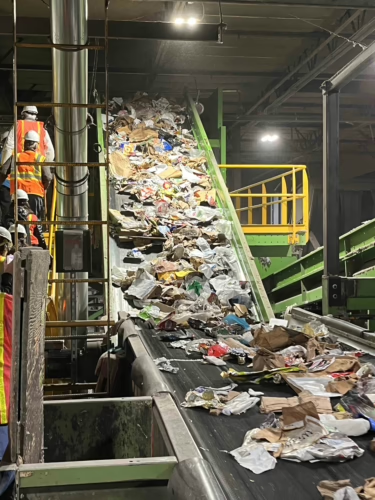
If anything, the noise intensified. Blowers were blowing the lighter materials up, grids with holes of various sizes were letting smaller pieces or cans fall through, and magnets were picking out the steel cans and chunks to separate them from aluminum and other non-ferrous metals. At one point a single one-armed robot was identifying and snatching small pieces that the operators had missed on the fast-moving conveyor belt.
Once the individual materials are separated (paper, cardboard, tin cans, plastic milk jugs, colored detergent bottles, etc.), they further refine the separated materials to remove the small pieces of foreign material that would contaminate a shipment. Finally, the separated materials are baled into six-foot cubes that weigh up to a ton apiece, and these are shipped to paper mills, steel plants, and plastic recycling facilities all over the country.
Pioneer prides itself in achieving a high degree of purity of the material for one main reason: the price they can command for it depends on the purity of their product. The accuracy of sorting is the heart of the operation. High purity equals higher prices; low purity, low prices. The market is a relentless disciplinarian, and Pioneer claims that their product maintains the highest purity in the business.
After touring the process up close, climbing up steel ladders, walking across catwalks, listening to explanations from our tour guide as we stood high up on platforms, and finally emerging on the plant floor, we went outside and gazed up at the bales of cardboard, plastics, steel cans, aluminum cans, and paper, all ready to ship out. With the background noise now at a minimum, our tour guide, Mike Smith, the Warehouse Manager offered us an impromptu Q & A session.
A few key learnings:
- Do you pay the trash haulers for the material they bring you? Answer: No
- How much of your end products do you ship overseas Answer: None – By Law!
- Are you able to sell all your products to recycling plants (Answer: Yes.)
The good news is that every scrap of the recyclable materials (those allowed in our curbside co-mingled recycling bins) is recycled; nothing is landfilled except the contaminants they pick out of the stream, roughly 5% of their intake. Tour participant Sara Hammons commented about the tour “I found it interesting that the materials get run through the facility multiple times if needed until they get to their proper place or are confirmed garbage.”
Surprisingly (for us, at least) the company pays their employees well, provides health care, paid vacations, time off, and other benefits, such as support for higher education of both employees and their family members. As a result, there is low employee turnover. We were impressed by the enthusiasm for their work that we experienced from everyone we met at Pioneer.
As Oregon’s new recycling law, the Extended Producers Responsibility Act, takes effect, funding will be provided to Pioneer and other MRF’s to use to enhance their existing equipment, including robots and AI technology. They will automate some of their picking lines even further, and they will increase their capacity to handle even greater incoming loads.
So in answer to our original question: Does your curbside recycling really get recycled?
You bet it does. Pioneer is banking on it.
May 13, 2026 | Recent, Schools, Waste Reduction
By Jirapa Wongwanich, LOSN Schools & Waste Reduction Action Teams
What began as a simple trash bin observation has grown into a collaborative sustainability effort connecting students, teachers, families, staff and community organizations across multiple schools in the Lake Oswego School District.
In March 2025, while volunteering at Palisades World Language School, I noticed how much food waste was ending up in trash bins each day. Like many families in our community, I had started separating food waste at home after learning about the city’s curbside composting program. The question naturally emerged: could students separate their lunch food scraps too?
That same evening, I attended a sustainability gathering co-hosted by Lake Oswego Sustainability Network and Lake Oswego School District, where a county representative shared how Clackamas County supports schools in managing their waste. Inspired by the presentation, I reached out to the Palisades Green Team leaders to explore whether lunch waste separation might be possible at our school.
We decided to begin with a simple Earth Day activity involving a limited number of classes. We created a short presentation to teach students about food waste, composting and a simple sorting process designed to minimize confusion and contamination:
- Only food goes into the compost bin,
- Leftover milk goes into the liquid bin,
- Unopened or uneaten food goes into the food-share bin.
Clackamas County provided bins and helped conduct a food waste audit, while teachers and volunteers guided students through the process. The kitchen staff also provided recommendations and support with cleanup and logistics. The response from students, teachers and staff was immediate and encouraging.

Soon after, I joined the Lake Oswego Sustainability Network Schools Action Team, where I met people who shared the same passion for sustainability and environmental education. That sense of community empowered and inspired us to do more for younger generations. LOSN created space for ideas, partnerships, and encouragement, showing how community collaboration can turn small ideas into meaningful change.
Earlier this year, the Lake Oswego High School Green Team invited the LOSN Schools Action Team to discuss lunch composting efforts at the high school campus. Seeing students genuinely passionate about food waste reduction and environmental responsibility energized both groups and inspired a broader vision: expanding lunch waste separation programs throughout the district.
As planning continued, support grew across the district, including collaboration with LOSD Nutrition Services, Facility Operations and Communications teams. Elementary schools began exploring how programs could work within their own campuses and routines.
Three schools, River Grove Elementary School, Lake Grove Elementary School and Palisades World Language School successfully expanded or launched school-wide lunch waste separation programs with support from Lake Oswego Sustainability Network.
Each school approached the work differently based on its own strengths and logistical challenges. Schools without cafeterias, such as Palisades and Lake Grove, needed creative solutions for setting up sorting stations in hallways and transporting collected waste outdoors. River Grove, the school with a cafeteria, had to manage a larger student population and faced higher risks of contamination. Lake Grove already had passionate teachers leading advanced food waste separation efforts with younger grades. River Grove benefited from an enthusiastic 5th grade leadership team and a supportive lead teacher, while Palisades relied on strong collaboration among teachers, staff and parent volunteers.
LOSN played a key role in connecting schools, volunteers, students and community partners by facilitating communication, sharing knowledge and helping turn ideas into action. Clackamas County continued supporting the schools by providing rolling bins, supplies and food waste audits. Teachers organized student helpers, school cooks and building engineers helped manage daily setup and supported logistics, and parent volunteers assisted with training and supervision. Members of the Lake Oswego High School Green Team visited elementary schools to guide younger students through the sorting process, creating meaningful peer-to-peer learning experiences. Many 5th grade students eagerly stepped into leadership roles, helping younger students sort waste correctly and building excitement around sustainability.
Across all three schools, one key factor stood out: collaboration. The success of these programs was not the result of one person or one group, but of an entire community working together: students, teachers, custodians, nutrition staff, administrators, volunteers, county partners and LOSN𐆑all contributing in different ways.
This growing effort is a reminder that meaningful change often begins with small, local actions and that students are ready and eager to make a positive impact on the environment. When schools, families and communities come together around a shared purpose, even a simple lunch routine can become an opportunity to teach leadership, environmental stewardship and collective responsibility for the future.
We hope this program will continue to grow, become institutionalized within the district and expand to more schools in the coming years. With continued collaboration among students, staff, families, community partners and district leadership, this effort has the potential to become a lasting part of school culture and sustainability education across the district.
Jun 16, 2024 | News, Recent
The fingerprints of climate change are becoming more pronounced. As prolonged heat and drought become part of the normal rhythms of the season, how do we take care of our trees? Unprecedented temperatures and seasons of drought can be extremely hard on trees, especially landscape trees in our urban forest. If they are not well-watered, harsh temperatures make trees more susceptible to insects and disease. Extended periods of drought can cause stress in both newly planted and mature, well-established trees.
Here are some tips collected from the City of Lake Oswego, Friends of Trees, and Portland Parks & Recreation to help you shift into summer plant care mode and help your landscapes handle and recover from spans of extreme heat.
Drought Stress
- Plants that are subjected to water stress drastically decrease their resistance to opportunistic pathogens and insect invasions.
- Research your trees! Some species are more drought sensitive than others and require specific cultural requirements for watering, soil quality and climate.
- When monitoring drought stress, City of Lake Oswego advises you to be on the lookout for sparse canopy, wilting foliage, yellowing leaves, premature fall coloration, or leaf drop.
Soil
- Soil quality and type has a large impact on how successful a watering method is.
- Observe your soil. How quickly does it dry out after rain or watering? Dry soil can cause tree roots to die and reduce a tree’s ability to absorb water when it does finally rain.
- Sandy soils need shorter watering intervals because water drains quickly. Clay and less porous soils should have longer watering intervals.
- Soil moisture should be checked by hand! Portland Parks & Rec suggests an easy way to test soil is to stick a long screwdriver at least 12 inches into ground below your tree and see how much resistance from the soil you receive. If you receive a lot of resistance, the tree needs more water. If there is mud sticking to the end of the screwdriver when you pull it up, the water has properly seeped into the root zone.
- Friends of Trees suggests mulching trees with 3-4 inches of organic mulch (woodchips, compost) to reduce soil evaporation and maintain a consistent soil temperature. Remember the root zone is as big as the tree’s canopy so you need to mulch a large area not just at the base of the tree.
General Watering Tips
- Water trees in the early morning or late evening to minimize evaporation.
- Irrigate slowly so water percolates deep into the soil and root zone. This video by Friends of Trees demonstrates an effective, slow-drip watering system using a five-gallon drilled bucket.
- Other effective drip irrigation systems include ooze tubes and soaker hoses
- When using hoses, make sure to move around different areas under the tree.
- Try not to water too much! Davey Trees has a helpful article about decoding your trees’ clues that they’re being overwatered.
Tips for Watering Young Trees
- Because most of the Pacific Northwest’s precipitation occurs in winter and early spring months, nature is not watering the young trees when they’re experiencing the most growth.
- Newly planted trees should be watered about 10 to 15 gallons of water each week in their first three summers after planting with an extra 15 gallons during dry spells.
- It’s best to water infrequently, once or twice a week during long heat waves,
- Irrigate slowly and deeply to encourage roots to grow deeper.
- To encourage roots to grow outwards, avoid watering a young tree too close to its trunk and stick to watering over the root zone between the trunk and the edge of its leafy canopy (dripline). This will expand the young tree’s drip line over the coming years.
- This helpful video module by Friends of Trees demonstrates three different watering methods for young trees:
-
- You can purchase 15-20 gallon watering bags at a nursery to place around young trees. Fill once a week, or twice during heat waves.
- Drill three small holes a half inch apart into the base of a 5 gallon bucket. Fill three times during the course of the day and rotate it around the tree’s root zone.
- Place a trickling hose in the root zone for 15-30 minutes once a week.
Tips for Watering Mature Trees
- This video by the US Forest Service recommends watering mature trees once or twice a month slowly and deeply to keep them happy during dry months.
- Circle a soaker hose around the outer edge, or drip line, of the tree canopy. This is where water naturally drips off the tree canopy when it rains.
- Don’t water your mature tree at the base of the trunk. Too much water will rot the roots.
- Turn on your soaker hose in the early morning or late evening and let the water seep in for at least one hour.
Apr 16, 2024 | News, Recent
An interview with Randy Mihalko, Owner STORM Landscape Services
How did you get the electric contract with the city?
We have a good relationship with the Public Works Department. They invited us to submit a proposal in 2021 for the landscape maintenance program for what they call the Multi-Site Landscape Maintenance contract. In order to be invited to submit proposals for their contracts you have to meet their criteria which we do. The contract selection process has a grading system based on price, experience, references, personnel, etc. We were selected for the contract based on their grading process. They requested two prices; one for gas equipment and one for electric equipment. Public Works then submitted both of those prices to the City Council to vote on. I had a meeting with them to answer questions about the gas versus electric and they voted in favor of the electric contract. I believe the vote was 4 to 3 so it was not unanimous.
How many electric crews do you have? How many gas crews?
We have 15 total landscape maintenance crews and 6 of them are strictly electric. The other 9 crews are gas with a few electric backpack blowers mixed in depending on the customer contracts.
Do you intend to add more electric crews? Does electric-powered work cost more than gas-powered work done by your company?
Yes, approximately 20-30% more depending on the scope of work. More deciduous trees and more lawn means higher percentage cost.
What are some of the other large accounts you have using electric equipment?
Electric contracts are with the City of Lake Oswego, Portland General Electric, and Providence Hospitals. Both are very large contracts. We have hybrid contracts with Mary’s Woods Retirement Community and Arranmore HOA.
Can you take on any more commercial work?
Commercial, yes.
What are the pros and cons of transitioning to electric landscaping equipment for commercial landscapers?
Pros…
1. quieter (less intrusive and healthier for customers and employees).
2. no emission (healthier for environment and employees)
3. less mechanical maintenance (no oil, spark plugs, filters, belts, etc to replace)
4. longer warranty period
5. fuel savings
Cons…
- initial cost of equipment is much higher
- 60″ mower is $24k for electric (Greenworks Optimus) versus $10k for gas (Exmark Vertex)
- backpack blower is $8k for electric (tool, chargers, 16 batteries) versus $600 for gas
- backpack blower is about half as productive as gas (all other equipment and mowers are same productivity as gas)
- invest in electric infrastructure to charge batteries
- up size circuit panel, install sub-panels, install additional circuits and outlets in shop $8k
- up size PGE meter (our panel is maxed based on the size of our meter, waiting 3 months for PGE design team, still unsure of cost)
- mobile refueling limitations
- with gas equipment we have cans of gas to refuel, with battery equipment it requires a mobile battery charging system
- fabricated a battery generator charging system in enclosed trailer $11k for trailer, $9k for battery generators and charging system
- install 30 amp RV outlets in the yard @ $4k per trailer
What advice would you give to other commercial landscaping companies transitioning to electric?
Plan on considerable start up costs as noted above and lots of training for employees. During leaf season plan on considerably higher labor costs to make up for the backpack blower production shortfall.
Mar 16, 2024 | News, Recent
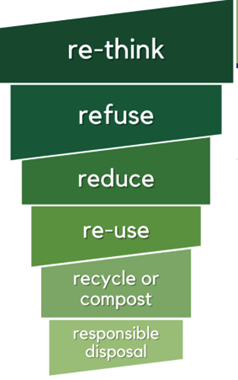
Most of us have heard the three R’s: Reduce, Reuse, Recycle. Since that time, there have been creative extensions that include rethinking and refusing. What do these words really mean? Why are they in a particular order? They are a hierarchy to represent what provides the greatest benefit: benefit to your pocketbook, benefit to the environment.
Choosing Products for Sustainability
The ten questions on choosing products for sustainability, help guide thoughtful purchasing decisions. The first question, Do I really need the product? can result in thought-provoking alternatives such as sharing or borrowing, inventive solutions as well as more thoughtful and reduced consumption.
- Do I really need the product?
- Is the product safe to use?
- Is it practical, durable, of good quality with a timeless design?
- Is the product made from renewable or recycled materials taken in a sustainable way?
- Are the manufacturing practices moving towards sustainability?
- How will I dispose of the product and with what impacts?
- What kind of package does the product have?
- How far has the product been shipped to reach the retail outlet?
- Is the product a good value for the money?
- Is there some environmental, health, personal, or economic benefit that outweighs the product’s environmental costs?
– from Debra Dadd-Redalia, Sustaining the Earth
Re-Think
- Share and borrow items
- Give experiences as gifts and rethink favors at events
- ASK: How do we re-think systems to avoid needless/wasteful consumption
Refuse
- Avoid freebies at events which collect dust in your closet
- Say no to plastic – use cloth bags, reusable bottles and to-go containers
Reduce – Buy Less Stuff
- Avoid packaging whenever you can.
- Take reusable bags and produce bags.
- Use reusable containers and take your mug.
- When something breaks, see if you can get it fixed. Bring it to a local repair fair
- Reduce use of single use paper; use cloth napkins, rags, and washclothes
Reuse
- Shop at secondhand stores.
- Subscribe to the Bold Reuse container services. Find Bold Reuse containers at New Seasons for use at the deli, bulk containers and olive bar. Many Portland area restaurants use Bold Reuse containers for to-go use.
- Reuse wrapping paper or create your own from brown paper bags or newspapers.
- When you have an item you no longer need, find someone who can use it on the Trash Nothing (free) website or donate it.
- When you need something on an occasional basis, check if it is available in the Lake Oswego Library of Things, or see if you can borrow it from a friend or neighbor
Recycle Wisely
If you use curbside recycling, verify that your items are on the Clackamas County curbside recycling list before putting them in the recycling bin.
If you have questions
- Call Metro’s Recycling Information Hotline at 503-234-3000
- Email Clackamas County at [email protected]
How effective is recycling for the materials we commonly recycle?
- Metals – recycling metals is very effective. For example, an aluminum can is almost infinitely recyclable and it is less energy intensive than making new cans. Manufacturing a new can is so energy intensive that a recycled aluminum can has a 95 percent smaller carbon footprint than making that same can from virgin aluminum.
- Glass – most glass (bottles and jars) can be recycled again and again.
- Paper – paper recycling is valuable and saves lots of emissions and trees. However, the effectiveness is limited by the number of times it can be recycled without degradation.
- Plastics are the most problematic because there are so many types which are not recyclable. The key to sustainability is to avoid plastic whenever you can.
Mar 16, 2024 | News, Recent
By Jim Newcomer, LOSN Materials Management Team
Amanda Watson manages the city’s sustainability program, and that includes managing responsibly the waste the city and its people generate. To get answers to some of the recycling questions we all face weekly, we sent her a couple of questions, and she provided answers that we can all use.
For citizens who mean well and intend to recycle as much as we can, it can be daunting to remember exactly what is recyclable. And when we look at a plastic object, we may want to recycle it even though the chart on the refrigerator doesn’t mention it.
To find out, many people call Amanda.
Answering those calls is not a simple job.
I was curious about what people want to know from the city coordinator who supervises all the collection choices. I asked her in advance of sitting down in person: what are the most frequently asked questions about recycling?
She wrote back:
What do I do with….?
Many of the questions I get about recycling and disposal are from people wanting to know how to responsibly get rid of more unusual or infrequently disposed of household items, everything from fluorescent light tubes to large amounts of cardboard to old office supplies.
People are always welcome to call me with questions, but the best first place to look would be Metro’s online Find A Recycler website. Just put in your address and what you are looking to dispose of, and you will get a list of locations sorted by distance to you for reuse, recycling, and/or disposal of those items. Metro also has a fully-staffed recycling hotline that people can call with questions: 503-234-3000.
Questions about recycling plastic
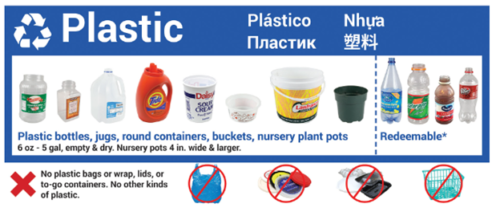
In the Metro region, whether or not plastic is recyclable depends on the shape and size of the item, not on the recycling symbol or number it may be labeled with. All plastic bottles, jugs, round containers and buckets between 6 oz – 5 gallons, and nursery plant containers 4 in wide and larger are recyclable. Caps and lids must be removed and put in the trash as they are too small to be sorted by the recycling machines.
This means that things like square plastic containers for berries and salad greens (“clamshells”) are not recyclable curbside. These need to go in the garbage, or they can be disposed of at New Seasons stores.
Unfortunately we do see people putting non-recyclable types of plastic into their curbside recycling bins hoping they are recyclable. While I understand the wish that more materials could get recycled, this “wishcycling” creates contamination which is costly for recycling facilities to sort out.
What do I do with old batteries?
As of 2023, residents of single-family homes in Clackamas County can recycle batteries curbside. Follow the preparation instructions in the graphic below.

Batteries are considered hazardous waste, and pose safety issues when they are improperly disposed of. If you don’t live in a single-family home, you will need to take your used batteries to the Metro south hazardous waste facility (disposal is free for household amounts) or a retail business in the area that accepts batteries for recycling (check Find a Recycler!).
When we met in person, she shared that we can expect some major changes in the coming year. In 2021 the Oregon Legislature passed the Plastic Pollution and Recycling Modernization Act, which is designed to ensure that plastics get recycled and that the companies that produce them pay to make it happen. When the law takes effect in 2025, she said, we can expect a simpler set of packaging materials, and we will be able to recycle most of them.